A Ban on Noncompetes? Don’t Expect One in Texas

Massachusetts Gov. Deval Patrick (Eric Haynes/Governor’s Office)

Massachusetts Gov. Deval Patrick has come out in support of banning covenants not to compete, claiming that they stifle innovation and send jobs and entrepreneurs fleeing to other states. He says companies would be protected against trade secret theft if Massachusetts would adopt the Uniform Trade Secrets Act (as Texas recently did).

So, does Gov. Patrick have a point? Would banning noncompetes unleash our economy and usher in an era of increased economic growth and mobility? It’s hard to tell. There could be an upside, economically, to a noncompete ban. But, even with the recent passage of the Uniform Trade Secrets Act, I don’t foresee a time when Texas would ban noncompetes altogether, because trade secrets aren’t the only reason employers ask employees to sign noncompetes.

One other important reason employers require noncompetes is that employers often provide specialized training. If specially trained employees could leave and instantly be hired at a competitor, that would be a major disincentive for employers to provide such training, and that would harm the company, its employees, shareholders and the economy as a whole.

And the Uniform Trade Secrets Act does nothing to prevent employees from immediately taking such specialized training to a competitor.

Another argument against banning noncompetes is that—by posing the threat of litigation if the noncompete is violated—they help prevent trade secret theft from happening. If, on the other hand, a company has to file a trade secret theft lawsuit because an executive has stolen trade secrets, the damage has already been done.

In other words, noncompetes effectively enforce themselves.

Admittedly, I’m not the president of the noncompete fan club. In fact, I represent the executives who are bound by them as well as the companies that require them to be signed. So, in every way possible, I can see both sides of the noncompete argument.

Noncompetes are a bit like patents. Patents create a monopoly, at least for some period of time. Critics complain that such monopolies are anti-competitive, and therefore bad for the economy. But without patent protection for inventors, much of the incentive to provide much-needed innovation is taken away. So we try to strike a balance–with the objective of incentivizing creativity and innovation but not creating a monopoly that lasts forever.

It seems to me that covenants not to compete should be treated with equal balance.

Fortunately in Texas, covenants not to compete must be reasonable in scope of activity, time, and geography—all of which limit the damage they can do to an individual’s career and entrepreneurial aspirations.

Rather than banning noncompetes, Gov. Patrick should examine the law in his state and see if it can be amended in such a way that it both protects employers and gives employees the freedom they need to ply their craft when and where they want.

What we have in Texas isn’t perfect, but it isn’t clear that taking the extreme position Gov. Patrick has taken would be perfect either.


Posted in CEOs, Complaints Against Executives, Non-Competes, Trade Secrets, Uniform Trade Secrets Act | Tagged , | Comments Off on A Ban on Noncompetes? Don’t Expect One in Texas

Company Secrets Come in Many Forms, and All Deserve Protection

The Cuckoo’s Calling wasn’t, as its dust jacked proclaimed, a debut novel penned by Robert Galbraith. It was written by beloved Harry Potter author J.K. Rowling.

After The Sunday Times broke the story, critics began to suggest that the revelation was merely an elaborate marketing ploy. It wasn’t a fantastic assumption, but Rowling insisted otherwise.

“I was yearning to go back to the beginning… to work without hype or expectation and to receive totally unvarnished feedback,” the author wrote on a website dedicated to her nom de plume. “If anyone had seen the labyrinthine plans I laid to conceal my identity, they would realize how little I wanted to be discovered.”

Then, in a “sheepish” statement released last Thursday, Rowling’s law firm fessed up.

According to The New York Times, the Russells Law Firm admitted that partner Chris Gossage had revealed Rowling’s secret to his wife’s friend, Judith Callegari, who promptly contacted a reporter via Twitter (then immediately deleted her tweets). The firm, which specializes in entertainment law, “apologized unreservedly” to Rowling, but clarified that the lawyer had spoken privately “to someone he trusted completely.”

As an attorney, what concerns me most is Chris Gossage’s complete disregard for client confidentiality – and its implications for the entire profession.

The incident, which has already netted Rowling several hundred thousand dollars (admittedly a drop in the bucket compared to her nearly $1 billion net worth), will certainly be more damaging to her lawyers than it will be to her publishers. I expect Russell’s faux pas will make many entertainment-business clients nervous that their lawyers will also leak privileged information.

Businesspeople who breach confidentiality – whether they’re revealing a trade secret to a competitor or gossiping with a trusted friend – always assume they won’t be discovered. Trouble is, they’re often wrong. They either leave a trail or the person they tell blabs, just as Judith Callegari did.

According to BBC News, the law firm, Gossage, and Callegari have apologized, and the firm has agreed to pay all of Rowling’s legal costs. It also agreed to make a payment to The Soldiers’ Charity, formerly known as the Army Benevolent Fund.

The moral of this story: never reveal company secrets, even to people you trust. If you believe you’ve unwittingly revealed confidential information, contact an experienced trade secret attorney.


Posted in Trade Secrets, Uncategorized | Tagged , , , | Comments Off on Company Secrets Come in Many Forms, and All Deserve Protection

Would Doc Rivers’ Non-Compete Fly in Texas?

The NBA just approved the trade of Boston Celtics coach Doc Rivers to the Los Angeles Clippers in return for Boston’s getting a first-round draft pick in 2015. This is obviously big news in the basketball world—Rivers is now reported to be the highest-paid coach in the league—but what I found so compelling about this drama was the breathless discussion of Rivers’ non-compete clause.

As a lawyer who represents executives in their employment contracts, non-competes are what I spend a good deal of my time drafting, re-drafting, negotiating and, occasionally, litigating. But it’s rare that I hear much talk of non-competes on ESPN.

Now, Rivers’ non-compete was no ordinary non-compete; there were some significant departures from the norm in his agreement. Two years ago, Rivers signed a 5-year, $35 million (or $7 million a year) contract with the Celtics. With 3 years left on the contract, Rivers was recruited by the Clippers. The snag was Rivers’ non-compete clause, which prevented him from coaching anywhere in the NBA until the end of his contract.

If Rivers were the coach of the Rockets or the Spurs—and his non-compete clause therefore governed by Texas law—it’s not likely that it would have been enforceable, if only because of the timeframe. Of course, under Rivers’ contract, he was being paid $7 million a year for every year of that 5-year contract whether he was coaching or sitting on the sidelines, which is most likely not the case in your run-of-the-mill contact.

However, in Texas, a covenant not to compete must be reasonable in terms of the geographical area, time period, and scope of activity restrained.  What is “reasonable,” of course, depends on what is necessary to protect the legitimate business interests of the employer. Generally, six months, or a year or two at most, is a reasonable time period. And, again, it would depend on circumstances. Also, although legally irrelevant, the fact that the executive is on “garden leave” (being paid to sit out during the non-compete) is probably a helpful fact for the employer with most judges.

But the threshold question is whether Rivers received any confidential information, specialized training or stock options in return for signing such a lengthy non-compete. Clearly specialized training should not be an issue. You wouldn’t think at the head coaching level, a team would pay that much and need to “train” them. And stock options, would rarely, if ever, be an issue. But is there confidential information in basketball? Well, there probably is concerning college prospects because yesterday’s draft sure surprised a lot of us. But that information is stale now, and there is no way that information could be useful for 5 years.

Geography is another issue in the enforceability of a covenant not to compete. Rivers’ contract prevented him from coaching for another team in the NBA. Considering that every NBA team plays every other team—even if it’s only a couple of times a year—it’s not a leap to consider every other NBA team a “competitor.” Granted, they may not all be “competitors” in the truest sense (no offense, Magic and Bobcats fans), but they are all still technically teams that play each other. So the geography in Rivers’ non-compete clause might stand up in Texas.

The final consideration for a non-compete in Texas is the scope of activity. His non-compete simply prevents him from a coaching job, which is probably enforceable. He could be a manager, a scout, or even a player. But not a coach. So he’s not completely shut down.

So it appears that the element of his non-compete that would be the biggest problem in Texas is the duration. Five years (the original length of his contract) would be tough to enforce in any situation in Texas, but under certain circumstances, I would think a court would modify it to one year (or one season).

Of course, it is important to keep in mind we are talking about the validity of the non-compete. Even if the validity of the non-compete were struck down, whether the team still has to pay him if he violates the non-compete (even if invalid) is a separate question in Texas. Under Texas law, if a contract provides that the employer can stop paying you if you compete, then the employer cannot stop you from competing. So you can’t get your cake and eat it, too. But at least it’s your choice. So, it’s still a nice clause to have in a contract, and it’s a good reminder why it’s important to have an experienced lawyer by your side when negotiating an employment agreement—whether it’s an NBA coach’s job or a Chief Operating Officer.

Bottom line: if I were representing Rivers and his contract were bound by Texas law, I would feel pretty good about our chances of getting him out of it.


Posted in CEOs, Executive contracts, Non-Competes | Tagged , , , , , | Comments Off on Would Doc Rivers’ Non-Compete Fly in Texas?

Forced Out and Bound by a Non-Compete

As a lawyer representing executives in non-compete disputes, I have always found covenants not to compete to be, to put it mildly, troublesome. To have such a patently anti-competitive tool in a free market system flies in the face of everything the free market is supposed to stand for. There is a place for them to be sure, but it still seems as if many of them are enforced for punitive reasons, not legitimate business ones.

If the intent is to keep former executives from using trade secrets or other confidential information in their new jobs, there are sometimes other, less onerous ways to keep that from happening (such as rigorously enforced confidentiality agreements).

In most cases, non-compete agreements are enforced when the executive’s departure was the executive’s choice. That’s bad enough, because nobody should be deprived of the chance to pursue a better employment opportunity, even if it’s for their current employer’s competitor. But at least, in that situation, it was the executive’s choice. And if there were a situation where somebody would use confidential information against a former employer, typically you would think it would be in this situation.

It is particularly galling, however, when an employer who has terminated an executive against his will chooses to enforce the non-compete and prevent the executive from making a living. These cases happen on occasion, and they essentially rub salt in the wound of an executive already smarting over the loss of a job he had no intention of leaving. Presumably, the employee had no intent to compete using confidential information against the former employer, because the employee had no intent to leave at all.

Non-competes have always been controversial, and some states (such as California) have essentially declared them unenforceable. That is not the state of the law in Texas, but I certainly would like to see more of an effort to rein in what can only be called abusive enforcement of covenants not to compete—such as happens when the executive had no plans to compete with her employer in the first place.


Posted in CEOs, Litigation, Non-Competes | Tagged , | Comments Off on Forced Out and Bound by a Non-Compete

Senate Bill Could Encourage More Trade Secret Litigation

A bill that would fundamentally change the nature of trade secret litigation in Texas is quietly working its way through the Texas Legislature as we speak. Senate Bill 953, by Texas Sen. John Carona (R-Dallas), would adopt the Uniform Trade Secrets Act in Texas, one of only three states that hasn’t already done so.

Right now, trade secret litigation in Texas is literally argued on a case-by-case basis.  Each case has its own facts, and appellate decisions have been written narrowly, sometimes conflicting with each other. The end result is that we live in an inexact world, trade secret-wise, and there’s probably something for everyone lurking out there in the trade secret common law. 

In that sense, having a Uniform Trade Secrets Act (UTSA) would be a boon. Of course, courts could still have conflicting interpretations of various provisions of the act, but we would all be starting from the same reference point.

The devil, of course, is always in the details.  And when it comes to the UTSA, one of the potentially problematic details is the inclusion of a “list of actual or potential customersor suppliers” in the list of what would be considered a trade secret. As one who is frequently called on to represent executives (and their new employers) who have been accused, in some form or fashion, of misusing a former employer’s trade secrets, this could be troubling.

Under our current (though admittedly flawed) system, customer identities are often not protected, particularly since it’s remarkably easy in the Internet era to learn who is whose customer. If a total stranger could obtain a list of a company’s customers through publicly available means (Google, LinkedIn, etc.), then why should an executive or her new employer be forbidden from using that same information?

If SB953 becomes law, this question will probably be addressed sooner rather than later. Right now, though, there doesn’t seem to be any organized opposition to Texas adopting the UTSA; at a March 25 Senate State Affairs Committee hearing on the bill, three people testified on behalf of the bill and nobody testified against it. So this is clearly not shaping up to be the Battle Royale of the 83rd Legislature.

If it passes—right now it’s pending in the House after being approved by the Senate—I predict it will make companies more likely to pursue trade secret litigation than they are now. In addition to it potentially expanding the amount of material protected as a trade secret, SB953, as drafted, includes a provision requiring the court to protect the alleged trade secrets by “reasonable means,” such as limiting access to the information to attorneys in the case, sealing the records, etc. That provision would probably lower the barrier for many would-be litigants who, in the current environment, have often decided not to pursue a lawsuit because doing so might mean the disclosure of the information they’re trying to keep confidential.

Knowing that the UTSA places a cone of confidentiality over their trade secrets (or, at least, what they claim are trade secrets) gives companies the peace of mind they might need to go ahead and file suit without fear that they’ll risk disclosure of the very information they’re trying to keep secret.

There are just about six weeks left in this legislative session, which ends on May 27. If passed and signed into law, the UTSA would take effect on September 1.

Executives looking to make the leap to another employer, you have been warned.

Posted in CEOs, Complaints Against Executives, Legal, Litigation, Trade Secrets | Tagged , , , , , | Comments Off on Senate Bill Could Encourage More Trade Secret Litigation

Trade Secrets: 2 Types of Thieves, 2 Types of Victims

American businesses are spending a significant amount of their time battling trade secret theft. In general, there are two kinds of trade secret theft, the kind done by employees and former employees, and the kind done by external institutions, often foreign governments or corporations.

The most common is the first kind, e.g. an executive leaves her company and takes client lists and other confidential information with her to her new employer. Sometimes the violation is unintentional and the executive was unaware the information was even considered a trade secret. Often, though, the theft was intentional and the executive and her new employer find themselves on the wrong end of a lawsuit.

This first kind of trade secret theft obviously isn’t ideal, and it can create huge losses for the companies whose information has been stolen. But this kind of theft is at least somewhat manageable.

The far more frightening and damaging kind of trade secret theft is the intentional hacking, often done from computer terminals half a world away. This is the trade secret theft that has American businesses—as well as our government institutions and military—on full alert.

To combat this pernicious threat, the Obama administration recently unveiled its “Strategy on Mitigating the Theft of U.S. Trade Secrets.” This strategy “includes diplomatic engagement with nations where incidents of trade secret theft are high, working with industries on the best ways to protect their secrets, and stepped up prosecutions of business espionage,” according to a report in USA Today.

U.S. Attorney General Eric Holder said that there are two kinds of companies affected by trade secret theft: “Those that know they’ve been compromised and those that don’t know it yet.”

And that’s not much of an exaggeration.

What’s so alarming is that, according to a recent report by the D.C.-based cybersecurity firm Mandiant, one of the chief alleged perpetrators of trade secret theft is a unit of the Chinese military, which Mandiant accused of cyberattacking more than 140 U.S. companies. The Chinese government denies involvement.

It’s good to see the Obama administration giving this issue the attention it deserves. Now, we just have to wait and see if the situation actually improves. I would never say “it can’t get any worse” because I don’t ever want to be accused of tempting fate. But the theft of trade secrets—particularly by other countries—has become a serious and ongoing concern for far too many American businesses.

Mr. Obama knows what’s at stake: national security, economic competitiveness and jobs.

It’s time for every American company—and their executives—to take this issue seriously.

Posted in CEOs, Trade Secrets | Tagged , , , , , | Comments Off on Trade Secrets: 2 Types of Thieves, 2 Types of Victims

Social Media Offers Risks, Rewards for Executives

Many U.S. companies and their executives rely on Social Media to build their brand, cultivate customer loyalty, and keep their finger on their customers’ collective pulse. Individual executives, like most people, probably also have their own Social Media presence, whether that’s on LinkedIn, Facebook, Twitter, Tumblr, Instagram, or whatever other new tool has become The Next Big Thing between the time I write this and the time it’s actually published.

Having a well-maintained Social Media presence can be a valuable career asset, but it must be meticulously tended. Indiscreet postings and photos, hackers, outdated profiles, and poorly maintained pages can mean an executive’s Social Media profile is more liability than asset.

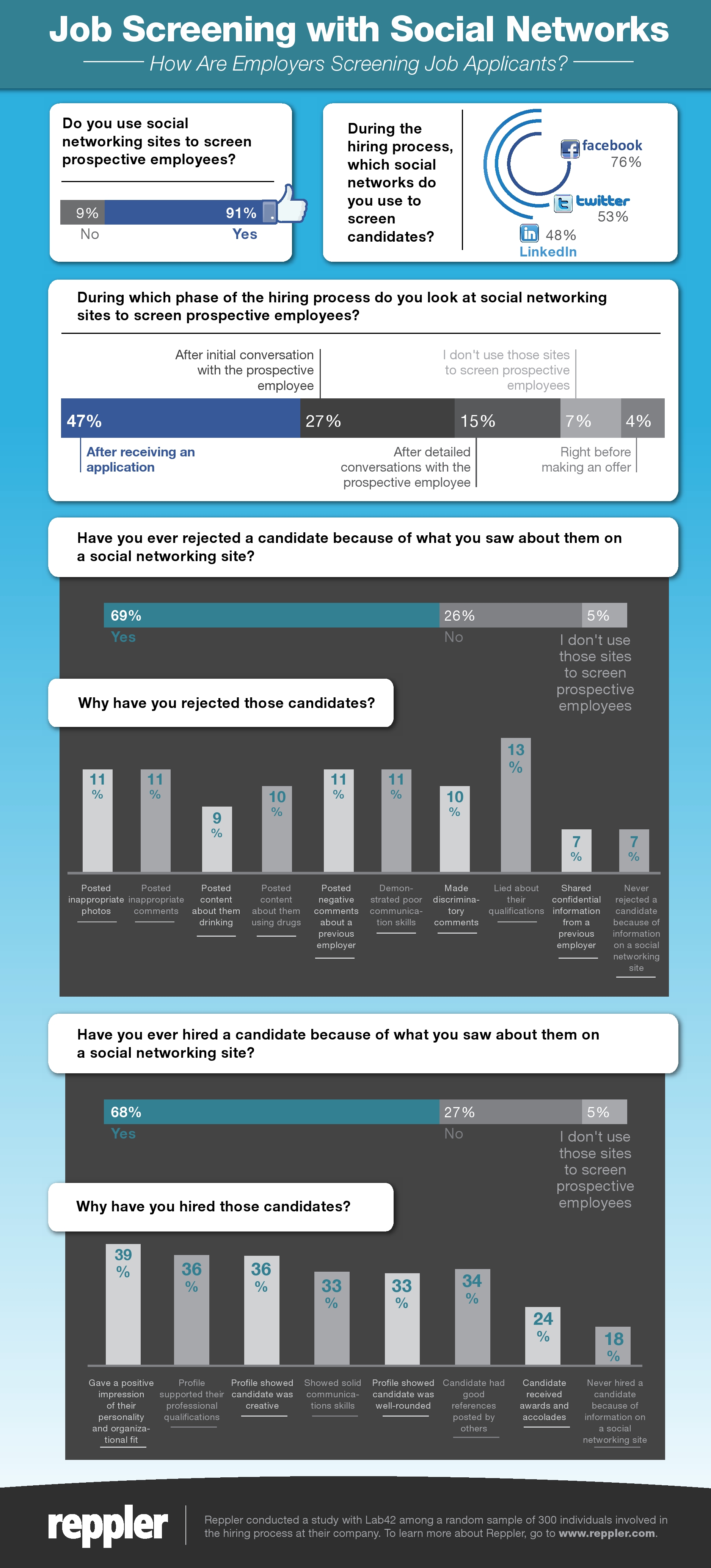
A 2011 study by the social media monitoring service Reppler found that 91 percent of the 300 employers it surveyed reported using social networking sites to screen prospective employees, with Facebook, Twitter and LinkedIn being the sites they screened most (in that order). Almost half of those employers did the Social Media screen after receiving an application but before an interview—in other words, before the applicant had a chance to charm them in person.

This study didn’t specify what level employees were the subjects of the Social Media screening, but executives, who are the face of the company, should expect to be even more highly scrutinized than other employees. They should assume, therefore, that every single thing they put on any Social Media site will be reviewed by their employer and/or prospective employer. 

Of the 300 employers surveyed by Reppler, 69 percent said they had rejected a candidate because of what they found on a social networking site. Things like inappropriate photos and comments, content that showed the applicant drank to excess or used drugs, lied about their qualifications, or posted negative comments or confidential information about a previous employer. “Demonstrated poor communication skills” was also a chief offender.

The good news is that almost as many companies, 68 percent, said that their Social Media screening actually helped the applicant because their online profile created a positive impression of his or her organizational and communications skills, creativity, professionalism, awards, references and overall well-roundedness.

So whether you’re in the job market or not, take a close look at your Social Media profile. Regardless of what your privacy settings are, make sure that everything you post online is something that would make a recruiter or hiring committee more, not less, likely to hire you.

Posted in CEOs, Social Media | Tagged , , , , , | Comments Off on Social Media Offers Risks, Rewards for Executives

Obama Signs Expansion of Trade Secret Law

Theft of trade secrets is a persistent issue in the executive suite, and the universe of possible violations recently expanded thanks to legislation signed into law by President Obama.

According to a report in Security Management, The Theft of Trade Secrets Clarification Act of 2012 amends the Economic Espionage Act of 1996 “to apply the prohibition against the theft of trade secrets intended to be used in interstate commerce even if those products or services are not directly used in commerce.”

The new law prohibits the theft of a trade secret that is ‘related to a product or service used in or intended for use in interstate or foreign commerce.’ Prior to this new law, a trade secret was more narrowly defined as ‘related to or included in a product that is produced for or placed in interstate or foreign commerce.’

The legislation was prompted by a decision handed down by the U.S. Court of Appeals for the Second Circuit in 2011. In the case, U.S. v. Aleynikov, the court ruled that the theft of proprietary source code by an employee was not trade secret theft because it was not directly used in interstate commerce, though the company did use it internally to create an advantage in the marketplace.

Clearly, trade secrets, as a potential landmine for companies and executives, aren’t going away. Companies must ensure they’re doing everything they can do protect their trade secrets and executives must remain vigilant that they don’t unknowingly put themselves in danger of trade secret-related litigation (particularly should they decide to change employers). When in doubt, consult an executive employment lawyer with ample experience in trade secret issues.


Posted in CEOs, Complaints Against Executives, Legal, Litigation, Trade Secrets | Tagged , , , | Comments Off on Obama Signs Expansion of Trade Secret Law

Preventing Trade Secret Theft (in 20 Years)

Trade secret theft becomes a bigger concern for major companies with every passing day. Particularly when companies are doing business overseas—where intellectual property protections may not be as well-enforced—keeping trade secrets secret has become, to put it lightly, a challenge.

The recent GM trade secrets case illustrates the issue perfectly. In that case, which ended on Dec. 1 with the conviction of a former GM engineer and her husband, GM’s hybrid technology trade secrets were found on at least seven computers owned by the couple. According to press reports, the couple had planned to take the trade secrets and go into business in China.

To be sure, companies must do a better job of policing their trade secrets and creating corporate cultures infused with honesty and integrity.  They simply need to do a better job of educating their own employees about the sensitive nature of the trade secrets, and the importance of keeping those secrets under wraps. However, wouldn’t it also be smart to start incorporating IP awareness into the curriculum at those universities where the creators of tomorrow’s technology breakthroughs are being nurtured and trained?

John Villasenor, a contributor to Forbes.com and a professor at UCLA, recently surveyed his graduate engineering students on their IP awareness. More than two-thirds of them said they didn’t know enough to answer the question “what is a trade secret?” They were not quite as ill-informed on the issues of patents, trademarks and copyrights, but the results were still not encouraging.

It’s not the students’ fault, Villasenor says. They’re in school, so if the school isn’t teaching it to them, then they can’t necessarily be blamed for not knowing it.

If those students—our future engineers and inventors—don’t know what a trade secret is today, and nobody sits down to spell it out for them at some point in the future, we can’t blame them if they don’t grasp their importance. As Villasenor writes:

 An engineer who doesn’t understand trade secrets and the obligations that accompany them is far more likely to walk out the door with proprietary computer code on a USB stick when he or she moves to a new job. Ignorance, of course, is not an excuse for trade secret theft. However, it contributes to a theft rate that is drastically underreported and almost certainly at epidemic levels. When trade secrets walk out the door, everyone loses – the company that invested in their development, the engineer who took them and who stands exposed to substantial civil and/or criminal liability, and third party recipients who could become embroiled in misappropriation allegations.

Today’s engineering and science students are tomorrow’s inventors and innovators. We need to be schooling them, today, on the importance of trade secrets and intellectual property rights.

It may not be on the test, but their—and our—future may be riding on it.


Posted in Corporate culture, Fiduciary Duty, Legal, Litigation, Trade Secrets | Tagged , , , , , | Comments Off on Preventing Trade Secret Theft (in 20 Years)

Former BBC Head’s Payout Adds to Network’s PR Woes

George Entwistle, the BBC’s former director general , resigned under fire recently over a two-pronged scandal involving the network’s handling of child abuse charges. The circumstances of the case are disturbing enough: the network allegedly covered up for one prolific abuser and unjustly accused another individual of abuse. But the BBC Trust, the broadcaster’s governing body, made it worse by giving Entwistle an overly generous payout when he left.

That’s a blatant violation of Ahmad’s First Rule of Resigning Under Fire: Don’t let your severance package cause more troubles for you or your former employer.

Granted, the $715,000 payout may not sound like much compared to many corporate severance packages, but Entwistle had only been at the helm for 54 days. And, according to press reports, that amount “was twice the amount to which he had been entitled under executive pay rules.”

In response to the kerfuffle, the BBC Trust justified the payout because Entwistle “will continue to help on BBC business, most specifically the two ongoing [internal] inquiries.”

From the looks of things, the payout is probably only the third or fourth biggest problem the BBC is facing right now. Nevertheless, why pile on?

Posted in CEOs, Complaints Against Executives, Executive Compensation, Severance Packages | Tagged , , | Comments Off on Former BBC Head’s Payout Adds to Network’s PR Woes